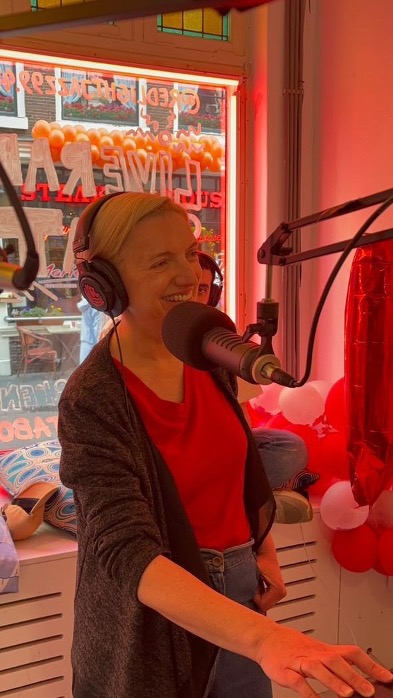
Director Stichting Kastanje Mariana Dzhulai on Radio Red Jazz:Â
On Her Path in Art, War, and Building a Cultural Center in the Netherlands
Mariana Dzhulai, Director of Stichting Kastanje, was invited to a live broadcast on Radio Red Jazz, where she spoke about her journey in the arts, the impact of war, and the creation of a Ukrainian-Dutch cultural center in the Netherlands.
In the interview, Mariana shared her story, from her first curatorial projects during her student years to founding the Ukrainian-Dutch cultural center Kastanje.
She began organising exhibitions at the age of 19, while still a student at the Academy of Arts, where she studied in the Art Management program, established in collaboration with the Netherlands. In her third year, she was selected as one of the top students for a three-month internship at the Utrecht School of the Arts.
At 25, she opened her own gallery, Block A, in Kyiv, after gaining experience working with several other galleries. Over the following years, she developed and produced dozens of projects, including large-scale exhibitions, multidisciplinary festivals, and museum initiatives. She also founded Ceramic Art Week, a commercially successful fair dedicated to contemporary ceramics. A significant part of her work has always focused on social and non-commercial projects aimed at preserving cultural heritage and supporting artists.
On February 24, 2022, everything changed. The following day, a new exhibition was supposed to open at her gallery, and the team was preparing the second edition of Ceramic Art Week.
After relocating to the Netherlands due to the war, Mariana began exploring the local art scene, attending fairs and pitching projects to galleries. However, these attempts were not successful. It was at that moment that she realised the urgent need to create her own institution, an independent Ukrainian-Dutch cultural center.
With this idea, Mariana approached the Embassy of Ukraine, which supported the initiative. Her first exhibition in the Netherlands took place there, where the Kastanje cultural center was also presented. This marked the beginning of Kastanje’s active work.
Today, Kastanje collaborates with the Ministry of Justice of the Netherlands, the University of Amsterdam, as well as galleries and cultural institutions in the Netherlands, Denmark, Germany, Belgium, Malta, and Ukraine. Over the past few years, the team has implemented more than 20 cultural projects, despite not having its own physical space.
The main goal is to establish a permanent cultural center and a gallery of Ukrainian art in Amsterdam, a space where Ukrainian and Dutch cultures can meet, collaborate, and enrich one another.
Currently, the team is actively looking for:
- a space for the cultural center in Amsterdam
- partnerships with municipalities, European funds, museums, and cultural institutions
“We are carrying out an important mission, introducing the world to Ukraine’s cultural heritage, to our cultural code that cannot be destroyed. We must preserve it for future generations and ensure it is never forgotten,” Mariana concludes.