This exhibition honours the life and artistic legacy of Ukrainian self-taught artist Polina Raiko, who transformed her home into a deeply personal universe of memory, faith, and resilience.
Following the destruction of the Kakhovka Hydroelectric Power Plant in 2023, her house, once recognized as a national cultural heritage site of Ukraine, was severely flooded and is now considered lost.
Through this exhibition, we remember, reflect, and preserve what can no longer be physically restored. The project invites visitors to encounter Raiko’s world, not as a distant past, but as a living memory that continues to resonate today.
The exhibition is currently on view, and we warmly invite everyone to visit and experience this powerful story.
Initiator and Project Author:Kastanje Dutch-Ukrainian Cultural Center
Partner and Co-organiser:Rasom
Curator:Mariana Dzhulai
Financial Support / Information Partners:Remember Together
Ukrainian Diaspora
Radio Ukraine The Netherlands
Exhibition “The House of Polina Raiko. Disappearing”This project, created in response to the destruction of the Kakhovka Hydroelectric Power Plant by Russian occupying forces, was presented at the Ukrainian House in Kyiv, as well as in Milan, Amsterdam, and Copenhagen. Today, thanks to the collaboration between Kashtanje and RAZOM, it is being presented in Haarlem.
Who was Polina Raiko, and why is this project important?Polina Raiko was an ordinary village woman who, throughout her life, hardly ever left her hometown of Oleshky in southern Ukraine. Sadly, she endured a tragic fate. The war reached her when she was still almost a child. Occupation, hunger, poverty. Deportation to Germany for forced labor, followed by a return to postwar Ukraine. All her life, Polina worked hard on the land — on the collective farm, in her own garden, and in her neighbors’ gardens for pennies.
She married and, together with her husband, built a house near the picturesque Dnipro floodplains. They had two children — a daughter and a son. But the bleak Soviet years, the lack of work and money, pushed her husband into alcoholism. Vodka turned him into a cruel man. He insulted and beat his wife. Their son grew up and followed in his father’s footsteps, eventually ending up in a penal colony. Yet the real tragedy struck when Polina’s daughter — her only joy and comfort — died in a car accident. Later, her husband died from alcoholism. Soon after, her son passed away as well.
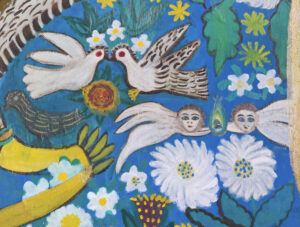
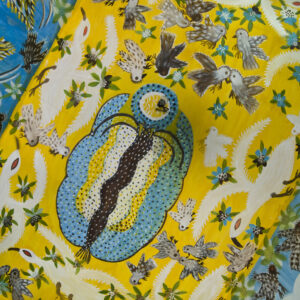
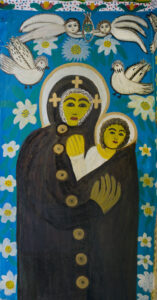
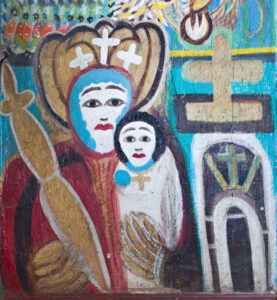
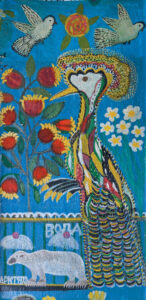
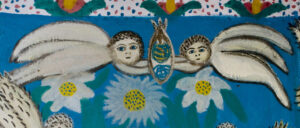
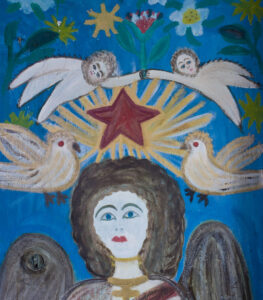
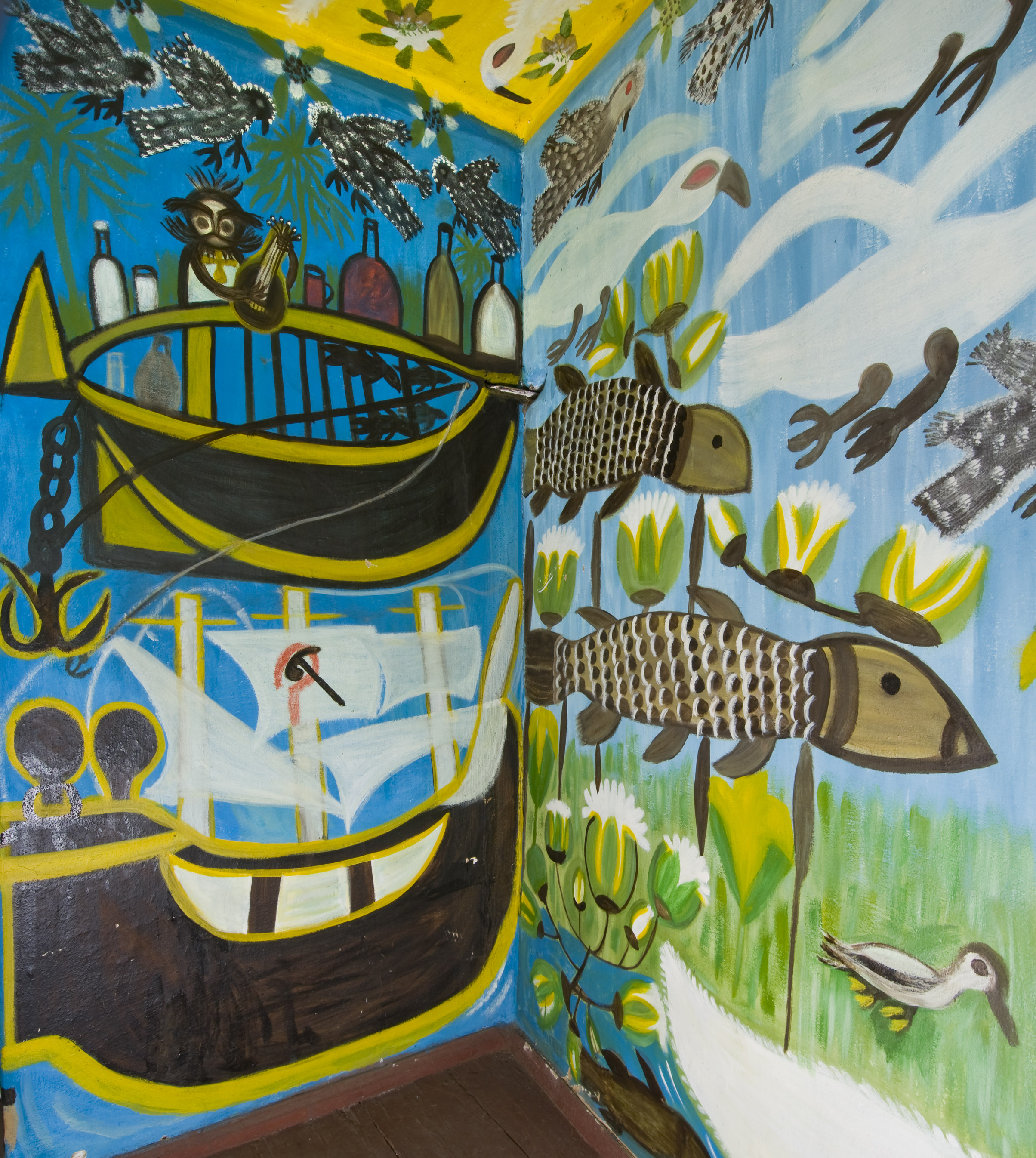
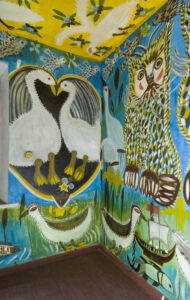
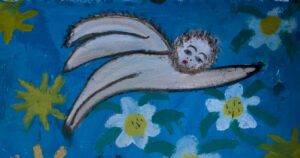
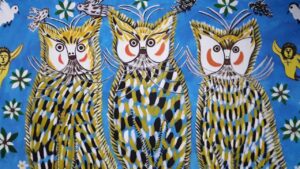
Left completely alone in her house at the age of 69, Polina unexpectedly began to paint. In a documentary filmed during her lifetime by Kherson television, she said it all started with a “dove of peace” that she painted on her gate. The process and its result brought her satisfaction and a small sense of joy. Within four years, every surface in her home was covered with incredible murals filled with beauty, love, and her personal life stories. When there were no surfaces left inside, she went outside — painting the garage doors, the summer kitchen, even decorating the gravestones of her relatives in the cemetery. Her final painting was a self-portrait, created on the back of a mirror. There were no free surfaces left in the house. Polina passed away in January 2004.
A year before her death, local historians and artists from Kherson visited her home. They were astonished to discover such a treasure. Polina gained recognition and began welcoming tourist groups. Grandma Polina gladly gave tours, explaining the symbols and meanings she had embedded in her frescoes. Visiting artists were deeply impressed by her talent and extraordinary imagination. Where did these vivid images come from, when there wasn’t even a television in her home, and she had never visited a single museum in her life? Her inspiration came from the breathtaking nature of the Kherson region where she lived and from her own memories. Polina’s visual language combines Christian, Soviet, and pagan symbolism — reflecting the rural life of her generation.
For nearly 20 years, many admirers of her work tried to turn Polina Raiko’s house into a museum and place it under state protection. Unfortunately, for many reasons, this never happened. Then, on June 6, 2023, catastrophe struck: Russian forces blew up the Kakhovka Hydroelectric Power Plant. The tragedy caused irreversible humanitarian and ecological consequences. The house, located on the riverbank, was flooded almost to the roof. When the water receded, a few photographs obtained from neighbors made it clear that Polina Raiko’s unique creation no longer existed. The region remains under occupation to this day. The fate of the house is unknown.
Thanks to the Polina Raiko Foundation — and in particular to Semen Khramtsov — we have the opportunity to experience something unique: through VR glasses, you can walk along the streets of Oleshky, enter Polina Raiko’s house, and move through all of its rooms. This small time machine transports you back to when the house was still whole.
Polina Raiko’s art — her murals, the pain and beauty of her soul — has now entered the realm of the intangible, the immaterial. It will remain alive as long as we preserve the memory of this highest expression of the human spirit, of the power of love that transforms any evil into beauty and gives hope.
Mariana Dzhulai
Curator of the project
Director of the Dutch-Ukrainian Cultural Center Kastanje
Polina Raiko